


All posts
Managing Supervision Recording Consent Well
Managing supervision recording consent in adult social care: a practical UK process for clear choices, secure records and inspection-ready evidence today.
Managing supervision recording consent in adult social care: a practical UK process for clear choices, secure records and inspection-ready evidence today.
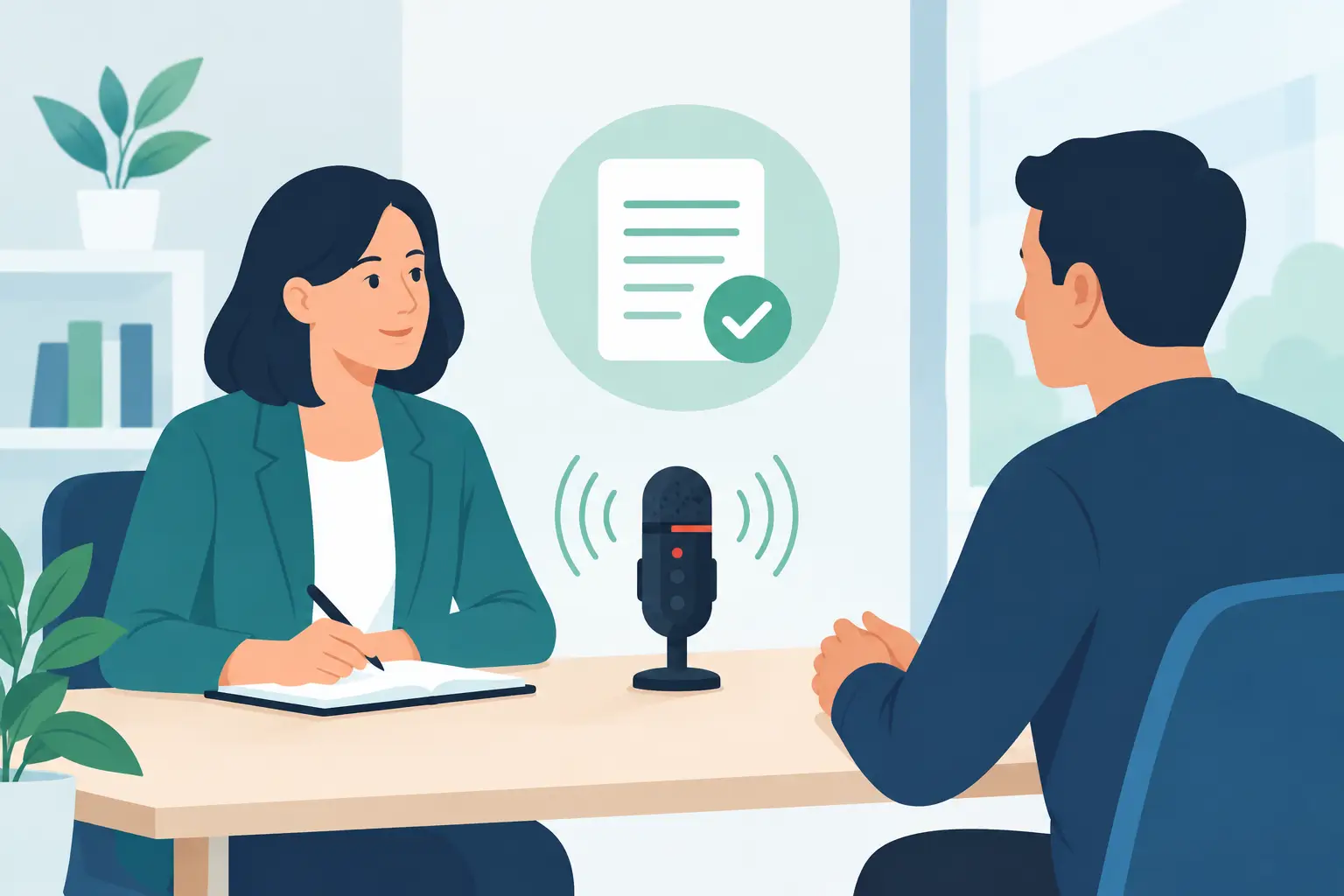
A manager presses record at the start of a supervision, and the conversation immediately changes. The staff member may wonder who will hear it, whether every word will be kept, and what happens if they say something difficult. Managing supervision recording consent is not a box to tick before getting to the real work. It is the first test of whether the session feels fair, purposeful and safe.
Let's be honest: supervision 1.0 is broken. Managers are expected to listen properly, identify risk, support development and then spend up to 45 minutes writing up a one-hour meeting from memory. Recording can remove much of that burden. But if the process is unclear, a tool intended to improve evidence can undermine trust instead.
The answer is not to avoid recording. It is to build a clear, repeatable process that respects staff, protects confidential information and gives your service a defensible record when an inspector asks how supervision is evidenced.
A recorded supervision contains more than an agenda and a list of actions. It may include performance concerns, wellbeing, learning needs, allegations, safeguarding matters, medication discussions or reflections on challenging shifts. The recording, transcript and final report are all personal data. In some circumstances, the content may be particularly sensitive.
That creates two parallel responsibilities. First, staff should understand what is being recorded, why it is needed, who can access it and how long it will be retained. Secondly, the provider must establish a valid lawful basis for processing under UK data protection law. These are connected, but they are not the same thing.
In an employment relationship, consent is not always the strongest legal basis because staff may feel they cannot freely refuse. Your privacy approach may instead rely on legitimate interests or, in some cases, legal obligations. That is a decision to make with your data protection lead and policy framework, not a reason to hide behind legal language.
Practical agreement still matters. A staff member deserves a plain-English explanation and a meaningful opportunity to ask questions before a recording begins. If they object, pause. Understand whether the concern is about technology, confidentiality, a particular topic or a need for an alternative arrangement. A blanket insistence can damage the candour that makes supervision valuable.
The easiest consent conversation is the one staff have already seen. Make recording part of your supervision policy and induction process, rather than presenting it as a surprise when the meeting starts. Explain the purpose: to create an accurate account of the discussion, reduce delayed write-ups and help managers act on issues consistently.
Your staff-facing information should answer four questions clearly: what is recorded; how the recording is transcribed and reviewed; who can see the original audio, transcript and final report; and when each item is deleted. Avoid vague promises such as “kept securely”. Say what secure means in practice, including access controls, encryption, UK data handling arrangements where applicable, and role-based permissions.
It should also be explicit that recording does not replace management judgement. A transcript is a record of words spoken, not a verdict on context, tone or capability. The manager remains responsible for checking the record, agreeing actions and correcting anything that is inaccurate before it becomes a formal supervision document.
Consistency protects both the manager and the member of staff. At the start of every recorded session, use a short spoken confirmation. For example:
“Before we begin, I’d like to confirm that this supervision will be recorded to produce an accurate transcript and supervision record. I will review it with you before it is finalised. The recording is stored securely, accessed only by authorised colleagues, and retained in line with our policy. Are you happy to proceed, or would you like to discuss any concerns first?”
This is not about forcing a yes. It makes the purpose visible, creates an auditable moment of transparency and invites a proper conversation where one is needed. Record the response in the session record. If the staff member does not wish to proceed, use the agreed alternative process and document that choice without judgement.
A good process separates the live conversation from the final record. That is where modern supervision technology can make a real difference: it should reduce typing without turning a private discussion into an uncontrolled data trail.
Start with a simple three-stage workflow.
Begin recording once the staff member has been informed and has agreed to proceed under your policy. Do not leave a device recording before or after the meeting, and do not use recordings for a different purpose later without considering whether that purpose is compatible and whether staff need to be told.
Keep the session focused. Managers should avoid including identifiable information about people supported unless it is necessary to address a specific safety or quality issue. Where an example is needed, use the minimum detail possible. If a serious concern requires escalation, follow your safeguarding or incident process rather than relying on a supervision recording alone.
Speaker-labelled, verbatim transcription can protect accuracy, especially when a manager is juggling a full service, staffing gaps and competing priorities. But accuracy is not automatic. Names can be misheard, technical terms can be transcribed incorrectly, and a short pause can change the apparent meaning of a sentence.
The draft should therefore be clearly treated as a draft. The manager reviews it, checks the issues raised, confirms actions and removes content that should not sit in the final supervision report. The staff member should have a chance to see and comment on the record in line with your policy. If they dispute wording, do not simply overwrite their view. Record the correction or disagreement fairly.
The final report should show what matters: the discussion, agreed actions, support required, review dates and any issues that need escalation. It should be dated, attributable and signed or acknowledged by both parties where your process requires it.
This is where platforms such as 1two.one can help managers move from recorded conversation to structured, regulator-aware evidence in minutes. Its value is not that it records more. Its value is that it helps turn the staff member’s actual words into a reviewable report, while identifying themes such as safeguarding, medication, competency or training for a manager to assess.
Consent wording alone will not make a recording safe. Your governance must match the reassurance you give staff. Before introducing recorded supervision, complete a data protection impact assessment where the nature and scale of processing creates a high risk to individuals’ rights and freedoms. Involve your data protection lead early, particularly if you use an AI supplier or roll out across multiple services.
Check your supplier arrangements carefully. You need a clear data processing agreement, a defined retention and deletion process, restricted access, encryption in transit and at rest, and a clear answer to whether audio or transcripts are used to train third-party models. “AI-powered” is not a security position.
Retention needs discipline too. Keeping raw audio forever because storage is cheap is difficult to justify. In many cases, the final approved report will meet the business need, while the original audio can be deleted after review and any appropriate challenge period. The right timescale depends on your policy, employment requirements and the purpose of the record. What matters is that it is documented, applied consistently and technically achievable.
Managers also need a clear route for access requests, correction requests and concerns about recording. If someone asks for a copy of their personal data, do not send a file without checking whether it contains information about another person or confidential service details. This is another reason to keep supervision conversations focused and to screen final records carefully.
A refusal is not necessarily misconduct, nor is it automatically a reason to abandon recording across the service. Ask what is behind it. A staff member may be anxious about a previous misuse of recordings, worried about their spoken English being transcribed inaccurately, or concerned about a sensitive topic.
Consider practical alternatives: a jointly reviewed written record, a manager’s typed notes confirmed during the session, or recording only part of the discussion. Be clear where recording is a standard organisational process, but remain proportionate. The aim is accurate evidence and meaningful support, not compliance theatre.
Where the refusal is linked to a disability, language need or other individual circumstance, seek appropriate advice and consider reasonable adjustments. A one-size-fits-all process is rarely the strongest governance.
Recorded supervision works best when it gives time back to the conversation itself. Managers can listen rather than type. Staff can see that their words have been captured accurately. Leaders can identify patterns early rather than discovering gaps during an inspection scramble.
But none of that starts with the record button. It starts with a calm explanation, a fair process and the confidence to pause when a colleague has a concern. Get that right, and recording becomes less like surveillance and more like what supervision should have been all along: evidence of a manager being present, listening carefully and following through.
Found this useful?
Share it with your network — help another registered manager save an hour today.