


All posts
AI versus paperwork in adult social care
AI versus paperwork is changing supervision in adult social care, turning recorded conversations into clear, reviewable evidence for inspection readiness.
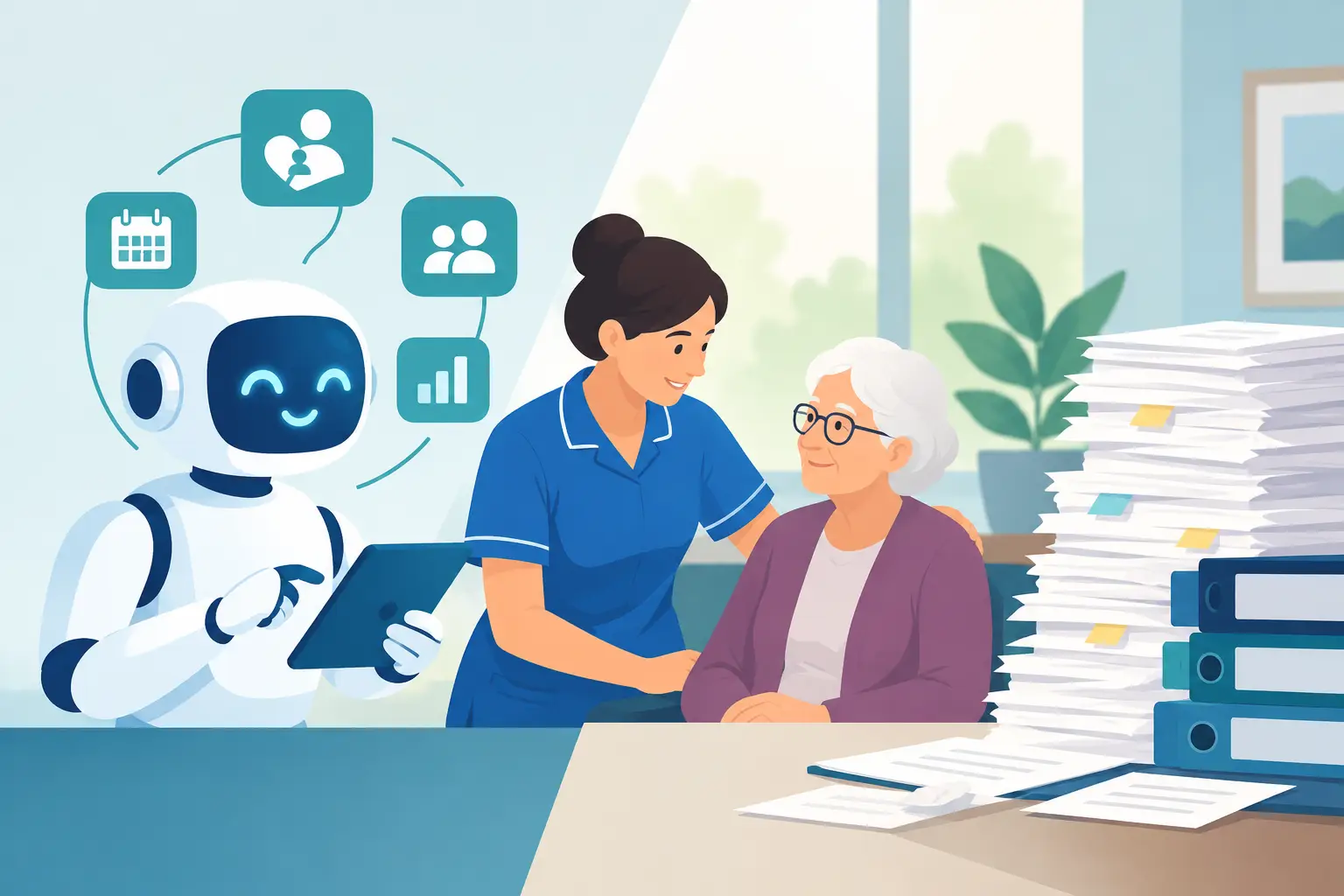
AI versus paperwork is changing supervision in adult social care, turning recorded conversations into clear, reviewable evidence for inspection readiness.
A one-hour supervision should leave a member of staff feeling heard, supported and clear about what comes next. Too often, it leaves the manager with another 45 minutes of typing, chasing a signature and trying to remember the exact words behind a concern raised three days earlier. That is the real problem in AI versus paperwork: not whether technology can write notes, but whether it can give managers their time back without weakening the evidence that matters.
Let's be honest: supervision paperwork has become a poor substitute for supervision itself. The conversation may be thoughtful, frank and useful. The record is often delayed, condensed into generic phrases, or completed from memory between incidents, calls and shift pressures. When an inspector asks what support was offered, how competency was discussed, or what action followed a safeguarding concern, a vague template does not inspire confidence.
Manual write-ups ask registered managers to do two demanding jobs at once. They must listen properly during the conversation, pick up on tone and uncertainty, ask the right follow-up questions, and create a defensible account afterwards. Under pressure, one of those jobs gives way. Usually, it is the paperwork that is delayed. Sometimes, more worryingly, the listening is interrupted by the manager making notes.
A standard form cannot solve this by itself. It may prompt useful topics, but it cannot show how a staff member described a medication concern, whether they understood a procedure, or how a manager responded to a confidence issue. Templates also encourage familiar wording: “discussed training”, “no concerns raised”, “staff member supported”. Those phrases may be accurate, but they are weak evidence unless the underlying conversation is clear.
This is not a criticism of busy managers. It is a recognition of the operating conditions they work in. A residential home, nursing service or domiciliary branch cannot pause while records are written up. Managers are dealing with staffing, families, safeguarding, quality checks and the reality of delivering safe, person-centred support. Administration has to fit around the work, which is exactly why it so often accumulates.
The cost is more than lost time. Late records blur detail. Missing actions make follow-up harder. Generic notes make internal audits slower and can leave an organisation scrambling to assemble evidence before a CQC, CIW, Care Inspectorate or RQIA inspection.
The best question is not, “Can AI replace a manager?” It cannot, and it should not. A manager brings judgement, professional curiosity, accountability and the human relationship that makes supervision valuable. AI can take on the mechanical burden of capturing, structuring and retrieving what was actually said.
That distinction matters. Poorly deployed AI can produce polished but unreliable summaries. If it invents detail, misses who said what, or applies a generic framework that does not reflect the nation in which the service operates, it creates a new compliance risk. Social care providers do not need more words. They need trustworthy evidence.
A well-designed approach to AI versus paperwork has three essential features: it preserves the spoken record, maps relevant discussion to the right regulatory expectations, and keeps a human reviewer in control before anything is finalised. The technology should support professional judgement, not imitate it.
For example, if a staff member says they are unsure about a medication process, that should not disappear into “training discussed”. The record should retain the relevant wording, identify the issue for review, show the agreed action and make it easy for the manager to follow up. The same principle applies to safeguarding, competency, wellbeing and development conversations.
The practical workflow is straightforward, but each stage needs to be done properly.
The session is recorded so the manager can stay present rather than type throughout. Both participants should understand why recording is taking place, how the information will be used and who can access it. Confidentiality is not an afterthought in adult social care. Systems need controls that respect UK data protection requirements and screen for resident-confidential information that should not sit in a staff supervision record.
Good speaker diarisation is equally important. A transcript that cannot reliably distinguish the manager from the staff member is less useful when assessing concerns, commitments and understanding. Speaker-labelled verbatim transcription preserves the distinction between what was asked, what was said and what was agreed.
Once the conversation is transcribed, AI can organise the evidence around the relevant supervision themes and regulatory framework. This is where a generic transcription tool falls short. England, Wales, Scotland and Northern Ireland have different regulators and inspection expectations. The record needs to be meaningful in the service's own context.
The output should be more than a summary. It should identify discussion points, agreed actions, review dates and evidence connected to areas such as safeguarding, medicines, training and competency. Where a concern appears, it should be visible rather than softened into corporate language.
For a manager, this removes the blank-page problem. Instead of replaying a conversation and constructing notes late at night, they review a report built from the actual discussion. That can avoid around 45 minutes of write-up after a one-hour supervision, while improving the consistency of the record.
This stage is non-negotiable. AI can detect patterns and prepare a report, but it does not know the full operational context. The manager must check accuracy, add context where required, correct anything that is unclear and ensure actions are proportionate. The staff member should be able to see the final record and sign it.
A signed PDF provides a clear point-in-time record for personnel files, internal review and inspection preparation. More importantly, the manager has acted on the conversation while it is still fresh. The value is not simply that a document exists. It is that the document is accurate, timely and usable.
The immediate gain is time, but the operational value builds over time. When every supervision is captured consistently, leaders can see recurring themes across a service or group. Are several staff members asking for the same refresher training? Is a competency concern appearing in more than one location? Are agreed actions being completed on time? These are governance questions that are difficult to answer when evidence is scattered across handwritten forms and inconsistent documents.
Better records also make supervision fairer. A staff member should not receive a weaker account of their conversation because their manager had a busier week. Grounding the report in actual words reduces the temptation to rely on assumptions or standard phrases. It creates a clearer basis for support, challenge and development.
There is a further benefit during inspection. Audit readiness is not about producing a mountain of paperwork when notice arrives. It is about being able to show an ongoing pattern of good management: regular conversations, identified risks, meaningful actions and documented follow-through. Evidence is stronger when it was created at the point of practice, not reconstructed retrospectively.
Not every AI tool is suitable for staff supervision. Consumer recording apps and generic meeting assistants may be convenient, but convenience is not the same as compliance. Before adopting a platform, providers should ask how recordings are secured, where data is processed, whether access is controlled, how resident-confidential material is handled, and whether transcripts are retained appropriately.
They should also test the quality of the transcription in real conditions. Social care conversations involve different accents, overlapping speech, acronyms, names and emotionally sensitive topics. If the system regularly confuses speakers or loses meaning, it transfers work back to the manager.
Finally, avoid treating generated reports as automatically true. Human review protects staff, managers and the organisation. It is the safeguard that turns useful technology into a reliable management process.
1two.one is built around this practical standard: record the conversation, analyse it against the relevant regulator framework, review the result and produce a signed report in minutes. The aim is not to make supervision feel more technical. It is to remove the bureaucracy that stops managers from being present in it.
Paperwork will always have a place in accountable services. But it should be the evidence of a good conversation, not the task that gets in the way of one. The most useful technology leaves managers with more attention for their staff, earlier sight of risk and records they can stand behind when it matters.
Found this useful?
Share it with your network — help another registered manager save an hour today.