


All posts
Compliance Evidence Platforms for Care Teams
Compliance evidence platforms turn staff supervisions into audit-ready records, helping UK care managers spot risks early and give time back to people.
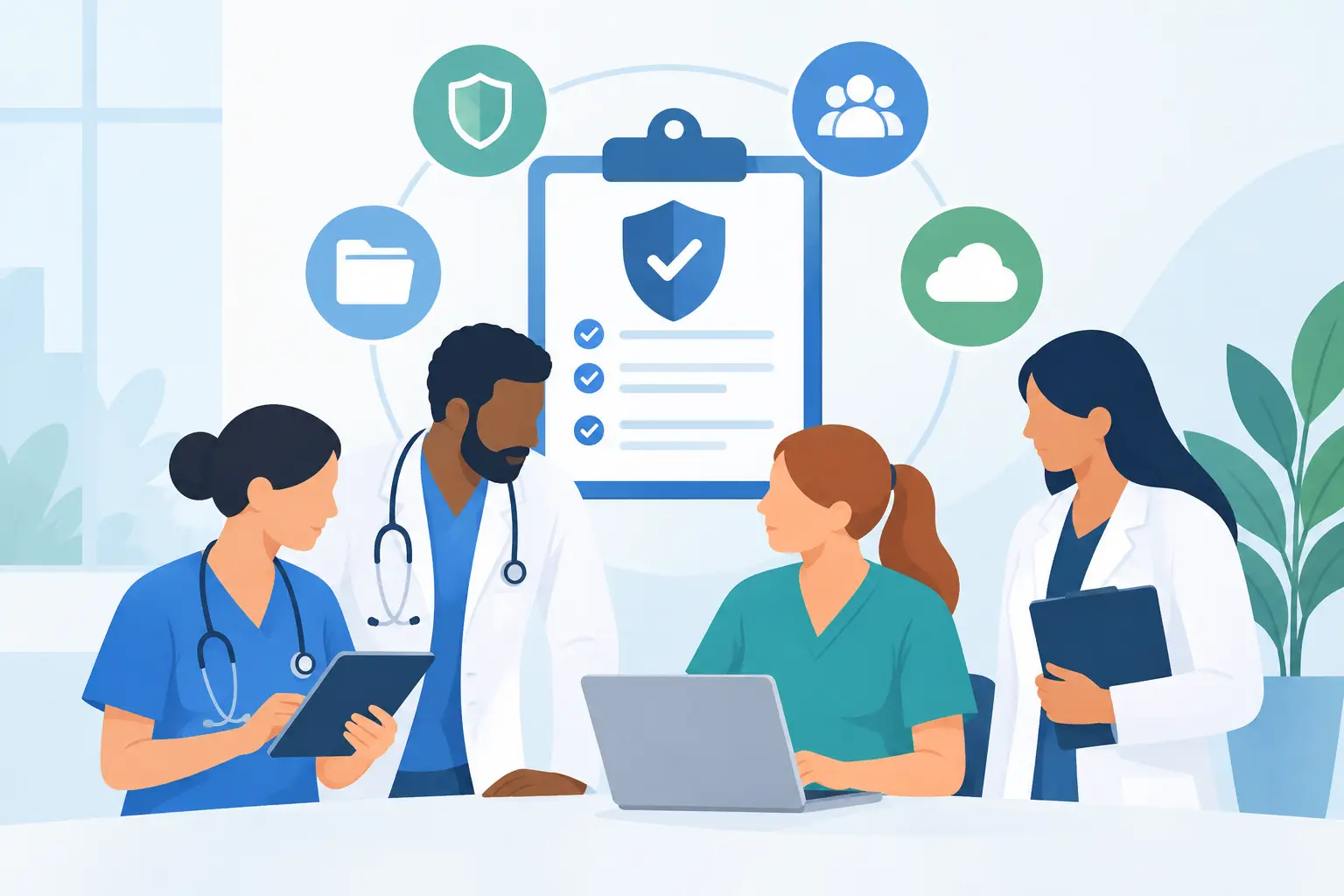
Compliance evidence platforms turn staff supervisions into audit-ready records, helping UK care managers spot risks early and give time back to people.
A supervision can be thoughtful, candid and professionally useful - then become almost impossible to evidence because the write-up happens three days later, between calls, incidents and a staffing gap. That is the real job compliance evidence platforms are being asked to do in adult social care: preserve what was actually said, turn it into a usable record and make sure important concerns do not disappear into a generic template.
Let's be honest. Managers do not need another system that creates more fields to complete. They need a way to run proper conversations with staff, identify issues while they are still manageable and leave the meeting with a credible record that can stand up to scrutiny.
Supervision 1.0 is broken. A manager holds a one-hour conversation, makes a few notes, then faces another 30 to 45 minutes of typing, formatting and trying to remember the wording and context. By the time the record is written, the detail has softened. The staff member's own words are replaced by a summary. Actions may be recorded, but the evidence behind them is thin.
This is not a criticism of managers. It is the predictable result of asking people who are already leading shifts, responding to family queries, supporting staff and overseeing safe practice to become full-time administrators as well.
The risks are practical. An inspection may reveal supervision records that are late, repetitive or unclear about whether an issue was explored. A competency concern may have been mentioned but not followed through. A safeguarding disclosure may sit inside a vague sentence rather than triggering an immediate, visible response. Across a multi-site provider, leaders may have no clear view of recurring themes until they become an operational problem.
A compliance record should show more than that a meeting happened. It should demonstrate active listening, professional challenge, staff development, agreed action and management oversight. It also needs to respect confidentiality. The answer is not to record every conversation without controls; it is to use technology designed for the sensitivity and regulatory reality of UK adult social care.
At their best, compliance evidence platforms convert a real supervision conversation into structured, reviewable evidence. They should reduce administration without reducing the quality of the conversation or removing professional judgement.
The workflow is straightforward, but the detail matters.
The platform records the supervision and creates a speaker-labelled, verbatim transcript. Good diarisation matters here. If it is unclear who raised a concern, who agreed an action or who offered support, the record loses much of its value.
A verbatim source gives managers something conventional notes cannot: a reliable account grounded in the staff member's actual words. It also means the manager can stay present in the discussion rather than attempting to type every key point while listening.
Accuracy has limits, of course. Accents, interruptions, clinical terminology and busy environments can affect any transcription tool. That is why a usable system must allow a human reviewer to check and amend the record before it is finalised. AI should remove the first draft burden, not silently become the author of the official record.
A transcript alone is not a compliance record. The value comes from applying the right regulatory lens to the conversation.
For providers operating in England, that means recognising evidence relevant to CQC expectations. In Wales, Scotland and Northern Ireland, the framework must reflect CIW, the Care Inspectorate or RQIA requirements respectively. A generic checklist cannot reliably do this. Different regulators may ask similar questions about leadership, workforce capability, safety and quality, but the evidence needs to be organised in language that makes sense for the jurisdiction and service.
This is where reasoning AI can support managers. It can identify discussion relating to safeguarding, medication, training, competency, wellbeing or conduct, then surface the relevant section for review. It can also distinguish between a routine developmental conversation and a point that needs an immediate management response.
The platform should not decide the outcome. A registered manager remains responsible for context, fairness and action. But being prompted to check a medication concern or an overdue competency assessment is far better than discovering it later during an audit.
The final output should be clear enough for the staff member to understand and strong enough for a manager, auditor or inspector to follow. That normally means an organised supervision report, agreed actions, a visible audit trail and an option for sign-off.
Signed PDF reports are useful because they create a stable, shareable point-in-time record. They should sit alongside controlled access, encrypted data handling and resident-confidentiality screening. Staff supervision often touches on sensitive events and personal information. Convenience is not a reason to be casual with data.
A platform built for UK social care should make its data protection approach plain: where data is processed, who can access it, how retention works and how records can be corrected. If a supplier cannot answer those questions clearly, it is not ready to hold supervision evidence.
Some managers hear “AI-generated report” and reasonably worry about generic prose. They have seen templated records that read well but say very little. Faster documentation only helps when it is more faithful to the conversation, not when it replaces it with polished filler.
The test is simple: can a reviewer trace an action back to the discussion that prompted it? Can they see what support was offered, what expectation was set and whether the staff member understood the next step? If the answer is no, the record may look complete but it is not defensible.
This is why human review is non-negotiable. The best systems do the time-consuming work - transcription, organisation, framework mapping and issue-spotting - while managers retain control of the final report. That balance protects authenticity and avoids the false confidence that can come from accepting automated text without reading it.
The immediate gain is time. If a one-hour supervision typically creates 45 minutes of follow-up writing, reducing that task to a focused review can return substantial management capacity across a team. That time can go into coaching staff, following up concerns and being visible in the service - not into reconstructing conversations after the fact.
The larger gain is earlier visibility. A single issue may be isolated. Repeated references to missed training, uncertainty around medication or inconsistent confidence in safeguarding are a management signal. When evidence is structured consistently, operational and compliance leaders can see patterns across services without reading every line of every record.
That does not mean every provider needs the same level of reporting. A small domiciliary service may prioritise simple, prompt records and oversight of a handful of staff. A large group may need service-level trends, governance reporting and controls that work across many locations. Pricing per care service rather than per supervisor seat can make adoption more realistic in either case, especially where supervision is shared across senior staff.
Do not choose on transcription quality alone. Ask whether the product maps evidence to the frameworks your services are inspected against, whether it clearly separates speakers, and whether managers can review every report before release. Ask how it detects potential safeguarding, medication, training and competency issues - and what happens when it does.
Also ask about confidentiality in practical terms. Can resident-identifying information be flagged? Are permissions appropriate for a multi-site organisation? Is there a clear audit trail for edits and sign-off? Technology should make governance easier to evidence, not create another governance risk.
Finally, test it with a real supervision scenario. A strong platform should feel less like form-filling and more like support for the conversation you already know how to lead. 1two.one, for example, is designed around that record-to-report workflow, with regulator-specific analysis and a human review stage before a report is finalised.
Good supervision has never been about producing paperwork. It is about noticing, listening, challenging kindly and acting early. The right evidence platform lets the record reflect that work - while giving managers more time to do it.
Found this useful?
Share it with your network — help another registered manager save an hour today.