


All posts
AI Transcription vs Manual Notes in Social Care
AI transcription vs manual notes: cut write-up time, keep evidence in staff voices, identify risks sooner and prepare confidently for every inspection.
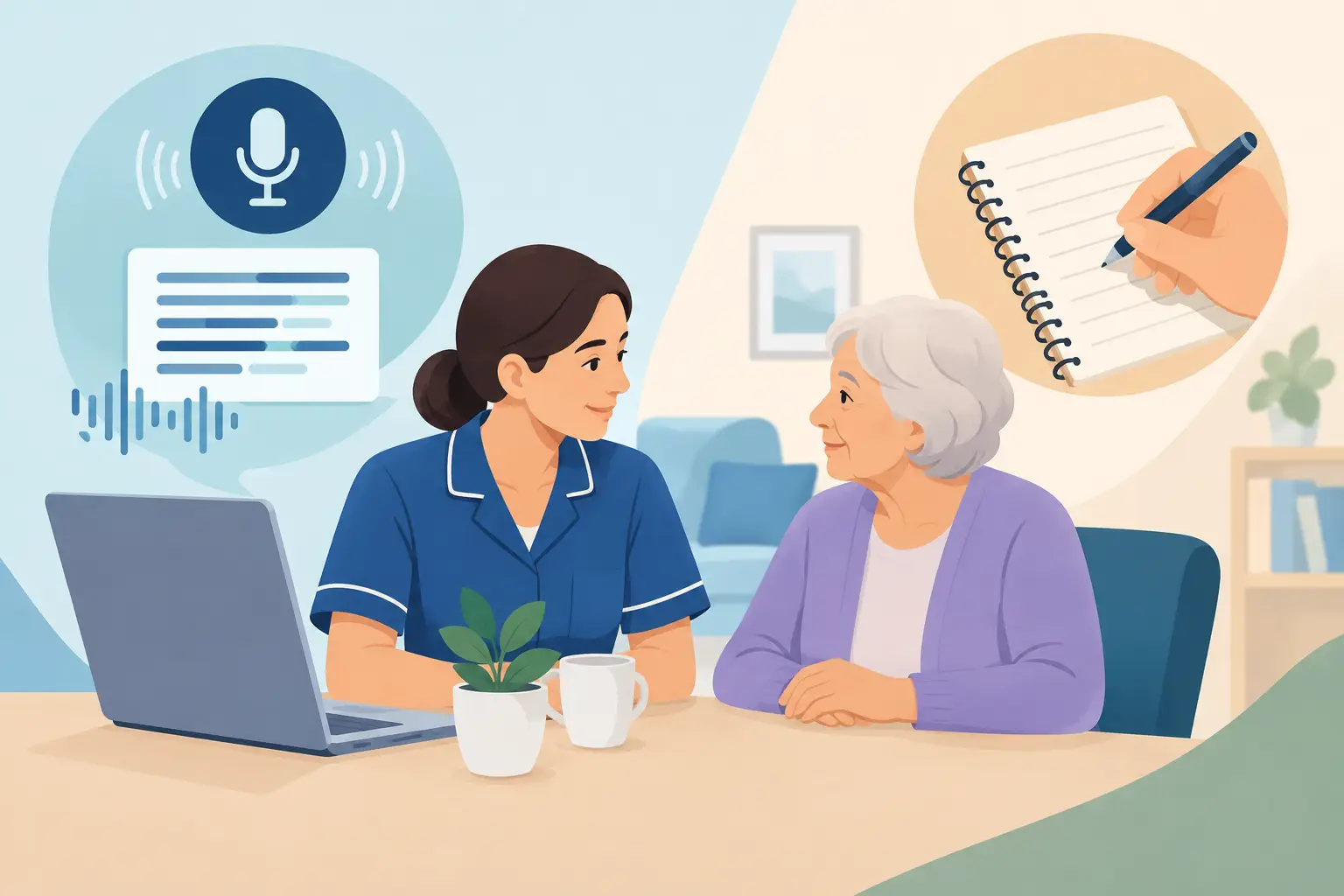
AI transcription vs manual notes: cut write-up time, keep evidence in staff voices, identify risks sooner and prepare confidently for every inspection.
A one-hour supervision should not create another hour of administration after the member of staff has left the room. Yet for many registered managers, that is exactly what happens: listen closely, make rough notes, remember the detail, write it up later, then hope the final record still reflects what was actually said.
That is the real question behind AI transcription vs manual notes. It is not simply about choosing a faster way to document a meeting. It is about whether supervision records can show meaningful support, sound management oversight and timely action when an inspector asks to see the evidence.
Let's be honest: Supervision 1.0 is broken. Good managers are being asked to be fully present in a conversation, spot concerns, coach staff and complete a defensible report - often while covering shifts, managing incidents and responding to families. Something usually gives. Too often, it is the quality and timeliness of the written record.
Manual notes are not inherently poor practice. A thoughtful manager can produce excellent notes, especially after a focused conversation with a small team. The problem is that the method depends on memory, time and consistency - three things adult social care managers do not have in abundance.
During the meeting, handwritten or typed notes force a choice. You either look down to capture every point, or you maintain eye contact and listen properly. Most managers try to do both. The result can be shorthand that makes sense on the day but loses context later: “Discussed meds”, “training needed”, “staff member happy”. Those phrases may record that a topic was mentioned, but they do not show what was explored, what assurance was given, what concern was raised or what action was agreed.
The write-up is often delayed too. A manager may complete notes at the end of a long shift, several days later, or in a batch before a quality audit. By then, the exact language, sequence and emphasis of the conversation have softened. Records become generic not because managers do not care, but because the workflow makes detail expensive.
That creates a governance problem. When a record is incomplete, it is harder to demonstrate that supervision was purposeful, that staff wellbeing was considered, that competencies were discussed and that risks were escalated appropriately. It also makes follow-up harder. The next supervisor is left to interpret a short summary rather than understand the conversation itself.
AI transcription changes the source material. Instead of relying on a manager's recollection, the system creates a speaker-labelled, verbatim account of the discussion. The manager can concentrate on the person in front of them, then review a reliable record afterwards.
That distinction matters. A transcript is not a finished supervision report, and it should never be treated as one without review. Spoken conversation can be repetitive, informal and occasionally unclear. But it preserves the evidence that manual note-taking routinely loses: the staff member's own words, the manager's response, the context around a concern and the commitments made by both people.
From there, the right platform can turn the conversation into a structured report aligned to the regulatory expectations that apply to the service. Rather than starting with a blank template, the manager reviews a draft that identifies key discussion areas, agreed actions and potential compliance issues. The manager remains accountable for checking accuracy, adding necessary context and approving the final record.
This is not automation for automation's sake. It is a better division of labour. Technology captures and organises the administrative evidence. Managers bring judgement, empathy, professional curiosity and decisive action.
A supervision meeting is often where a member of staff first voices uncertainty: they may be worried about a medication process, lack confidence in a task, describe a safeguarding concern or mention training they have not yet received. If a manager is trying to transcribe the discussion manually, those signals can be missed or reduced to a vague line in the final notes.
With ambient recording and clear speaker diarisation, managers can stay engaged. They can ask the second question, clarify what happened and make sure the staff member feels heard. The record then supports that quality of conversation rather than competing with it.
For providers, this has a practical benefit: concerns can be identified earlier and tracked more consistently. A properly designed system can flag references to safeguarding, medication, competency or training for manager review. It does not decide that a risk exists. It ensures a potentially important issue is not buried in a rushed write-up.
AI transcription is not the answer to every interaction. A brief corridor check-in, a simple confirmation of a rota change or a short factual conversation may not need a recorded transcript. Proportionate documentation still matters.
There are also situations where recording may not be appropriate, or where consent, privacy and local policy require particular care. Adult social care providers must be clear about why conversations are recorded, who can access them, how long information is retained and how confidential details are handled. A useful tool does not remove these responsibilities. It should make them easier to meet.
Data protection deserves more than a tick-box statement. Providers should look for UK-appropriate controls, encryption, clear retention settings, restricted access and processes that screen for resident-confidential information. They should also ask whether the platform separates speakers accurately. If the transcript cannot reliably show who said what, its value as evidence drops sharply.
The final trade-off is human oversight. AI can organise a conversation against CQC, CIW, Care Inspectorate or RQIA expectations, but it cannot know every relevant operational fact. A manager may need to correct a name, explain a local issue or record an action taken after the meeting. Human review is not an optional extra. It is the point at which a useful draft becomes a professional record.
The most effective workflow is simple enough to use when the service is busy. It should follow three clear stages.
First, record the supervision conversation with appropriate transparency and consent. The manager leads the meeting as a meeting, not as a note-taking exercise.
Second, receive a speaker-labelled transcript and structured analysis. The system should draw attention to themes discussed, actions agreed and issues requiring consideration, while mapping the conversation to the relevant regulatory framework.
Third, review, amend and sign off the report. This is where the manager confirms the record is accurate, decides what follow-up is required and creates an auditable trail of supervision that is grounded in the staff member's actual words.
1two.one is designed around this record-to-report model for UK adult social care. It converts recorded supervision into structured, signed PDF evidence while giving managers a human review stage before anything is finalised. That matters because the aim is not to produce more paperwork. It is to produce records that stand up to scrutiny and help managers act.
Inspectors are unlikely to be reassured by a folder full of identical templates with the same broad statements copied from month to month. They need to see that supervision is regular, individualised and connected to safe, effective practice.
A stronger record shows the actual subjects discussed, the support offered, any learning needs identified, actions with ownership and evidence that previous actions were revisited. It also gives operational leaders a clearer view across services. Are certain training themes recurring? Are medication concerns being raised in one branch? Are managers completing follow-up actions promptly? Manual notes can contain these answers, but extracting them across dozens of conversations is labour-intensive and unreliable.
AI-supported records make that evidence more accessible. The benefit is not just saved administration, although avoiding roughly 45 minutes of write-up after a one-hour supervision is significant. It is the ability to turn ordinary management conversations into usable governance insight before an inspection date forces the issue.
For a small service with occasional, short supervision meetings and plenty of protected management time, manual notes may remain workable. The test is whether records are completed promptly, accurately and consistently - not whether they are handwritten or digital.
For a busy home, domiciliary branch or multi-site group, the calculation changes quickly. If managers are routinely writing notes late, relying on generic templates or struggling to evidence what was discussed, the process is carrying unnecessary risk. AI transcription can reduce that burden, provided it has the right safeguards, regulator-aware structure and a meaningful human approval step.
The standard should be higher than “we have a form completed”. Staff deserve managers who can listen without one eye on a notebook. Managers deserve systems that respect their time. And providers deserve evidence that reflects the care, curiosity and accountability already present in a good supervision conversation.
Start with one practical question: after your next supervision, could an independent reader understand what the staff member said, what you did in response and what will happen next? If the answer is not consistently yes, the issue is not your commitment. It is the process asking you to do too much at once.
Found this useful?
Share it with your network — help another registered manager save an hour today.