


All posts
Care Transcription Tools That Stand Up to Inspection
Care transcription tools can cut supervision write-up time while creating accurate, regulator-ready evidence, helping managers spot risk and act sooner.
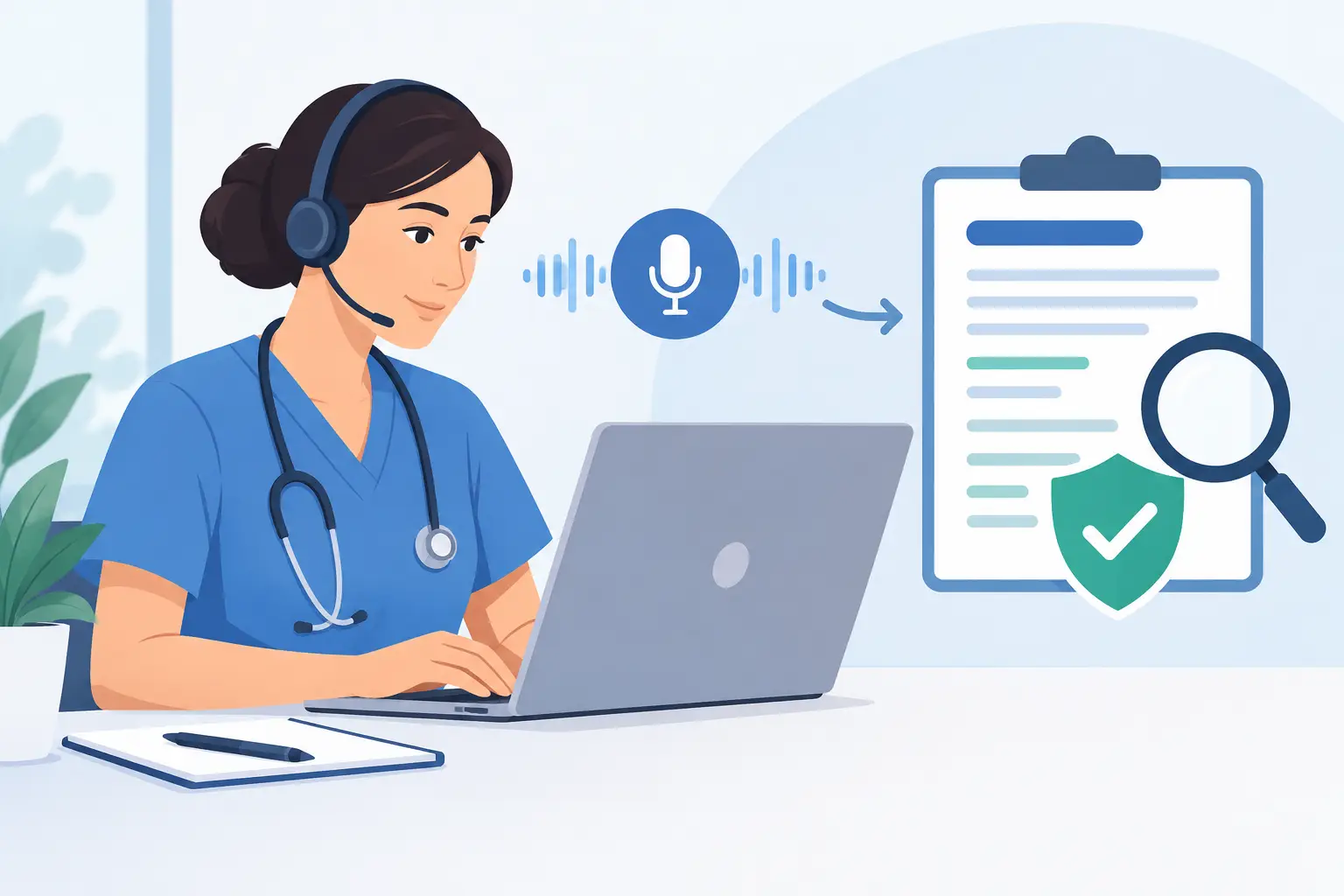
Care transcription tools can cut supervision write-up time while creating accurate, regulator-ready evidence, helping managers spot risk and act sooner.
A one-hour supervision should not create another 45 minutes of typing after the staff member has left the room. Yet for many registered managers, that is exactly what happens: listen carefully, take partial notes, write up the conversation later, chase signatures, then hope the final record reflects what was actually said. Care transcription tools offer a better route - preserving the conversation while turning it into useful, audit-ready evidence.
Let's be honest: Supervision 1.0 is broken. It asks managers to be fully present with a colleague and produce flawless documentation at the same time. When the shift is busy, the write-up slips. Details become vague. Actions are recorded without the context that explains why they mattered. By the time an inspector or auditor asks for evidence, the record can look thinner than the conversation ever was.
The point of transcription in adult social care is not to create more paperwork in a different format. It is to give managers back the time and attention needed to lead people well, while creating a dependable record of supervision, concerns, support and agreed next steps.
A good supervision conversation is human. It may cover confidence, workload, training, a difficult interaction, medication practice, safeguarding awareness or a concern that has been sitting quietly in the background. The manager needs to hear what is being said, ask the right follow-up questions and respond appropriately. They should not be trying to type every sentence.
Traditional templates have their place, but they often flatten the discussion into a few boxes. A template can show that supervision happened. It does not always show the quality of management oversight, the staff member's own words, how risks were explored or why an action was agreed.
That distinction matters under scrutiny. CQC, CIW, the Care Inspectorate and RQIA expect providers to demonstrate effective governance, competent staff, responsive leadership and action when concerns arise. A generic note saying “discussed training” is weak evidence. A clearly attributed record showing that a worker identified a gap, a manager tested their understanding, agreed support and set a review point is considerably stronger.
The right tool helps make that level of evidence practical at scale. It does not replace management judgement or turn supervision into a compliance performance. It removes the administrative drag that prevents good supervision from being recorded properly.
The most useful care transcription tools follow the natural shape of a supervision rather than forcing the conversation around a form.
The session is recorded securely, with participants aware that it is being captured. This should never be a hidden process or a shortcut around trust. Staff need to understand what is recorded, why it is recorded, who can access it and how the final record will be used.
For UK adult social care, data protection is not a feature to add at the end. The platform should use suitable security controls, restrict access appropriately and recognise the sensitivity of resident information. It should also identify references that may create confidentiality issues, so managers can review them before a record is finalised.
Recording quality matters too. A system that cannot distinguish speakers creates confusion at exactly the point a provider needs clarity. Strong speaker diarisation - identifying who said what - makes the transcript usable as evidence and avoids attributing concerns or commitments to the wrong person.
A verbatim transcript gives managers something handwritten notes cannot: an accurate account grounded in the staff member's actual words. It captures the nuance of a discussion, including questions, clarifications and commitments that might otherwise disappear in a rushed summary.
But a transcript on its own is not the finished job. A sixty-minute conversation can produce many pages of text. Managers do not need another document to read line by line after every supervision. They need help locating what deserves attention.
This is where reasoning AI can support oversight. It can analyse the discussion against the regulatory framework relevant to the service, surface themes and point to possible evidence gaps. It can flag a mention of missed medication competency, uncertainty about safeguarding thresholds, an overdue training need or a wellbeing concern that requires a manager's follow-up.
A flag is not a finding, and it should not be treated as one. Context matters. A staff member may be describing a historic issue that has already been resolved, or asking a sensible question that demonstrates good professional curiosity. Technology should direct attention, not make unsupported decisions about people or risk.
Human review is the safeguard that turns assisted transcription into a trusted management record. The manager checks the proposed summary, corrects any transcription error, confirms actions, removes information that should not be retained and ensures the document fairly represents the conversation.
Once reviewed, the record can be organised into a consistent report with agreed actions, ownership and review dates. A signed PDF gives the service a clear, stable record that can be retrieved when needed, rather than a loose note stored in an inbox or a shared drive with no obvious trail.
This workflow is not about automating accountability away. It makes accountability easier to evidence. The manager still listens, decides, supports and follows up. The system captures and structures the proof.
Not every transcription product is suitable for adult social care. A general meeting recorder may produce text quickly, but speed is only one part of the requirement. Before adopting a tool, providers should test it against the realities of regulated care.
First, ask whether it understands the frameworks that apply to your services. A provider operating across England, Wales, Scotland or Northern Ireland may need regulator-specific analysis rather than generic workplace themes. The output should help managers identify relevant evidence, not force every conversation into vague corporate language.
Second, look closely at accuracy and speaker labelling. Accents, care-sector terminology, names, abbreviations and conversations involving more than two people can all test a system. Ask to see how corrections work and whether the final record visibly distinguishes the manager from the staff member.
Third, examine confidentiality and governance. Where is information stored? Who controls access? How are recordings and transcripts retained or deleted? What happens when a conversation includes a resident's name or sensitive personal information? A supplier should answer these questions plainly, without hiding behind broad assurances about AI.
Finally, consider the manager's workload. If transcription creates another review queue that takes half an hour per session, the benefit will be limited. The useful measure is not simply minutes of audio processed. It is whether the workflow reduces the time between supervision happening and a high-quality, signed record being available.
Saving 45 minutes of write-up time after a one-hour supervision is significant. Across a care home, domiciliary branch or multi-site group, that time adds up quickly. But the bigger gain is timeliness.
When records are completed promptly, actions are less likely to disappear into the gap between a conversation and the next admin session. Managers can respond sooner to emerging safeguarding concerns, medication issues, competency gaps or a colleague who needs additional support. Compliance evidence also builds continuously, rather than being assembled in a panic before an inspection.
This changes the character of supervision. Instead of feeling like a form-filling obligation, it becomes a reliable source of management insight. Patterns can be seen across teams without reducing individuals to data points. Leaders can ask better questions: Are the same training concerns appearing in several services? Are staff consistently unsure about a particular procedure? Are managers closing actions when they say they will?
For large groups, consistency is a major advantage. For smaller providers, the benefit may be simply having a defensible record without paying for an administrative function they do not have. A service-based subscription model, such as the approach used by 1two.one, can be more practical than paying separately for every manager who needs to complete supervision.
There is a reasonable concern that recording supervision could make conversations feel formal or inhibited. That risk is real if the process is poorly introduced or treated as surveillance. The answer is not to avoid better records. It is to set clear expectations, gain appropriate consent and make the purpose explicit: accurate documentation, fair representation and better follow-through.
Used well, transcription lets the manager put the notebook down, maintain eye contact and listen for what sits beneath a standard answer. It protects the staff member from having their words reduced to a hurried paraphrase. It also protects the service when it needs to demonstrate that concerns were heard and acted upon.
The best care transcription tools do not make supervision less human. They remove the bureaucracy that has too often distracted from the human conversation in the first place. Start with one question: after your next supervision, will the record show what really mattered - and will it help you act on it while there is still time?
Found this useful?
Share it with your network — help another registered manager save an hour today.