


All posts
Best Confidential Recording Practices for Care
Best confidential recording practices for UK adult social care: consent, privacy, secure storage and review steps that protect staff, residents and evidence.
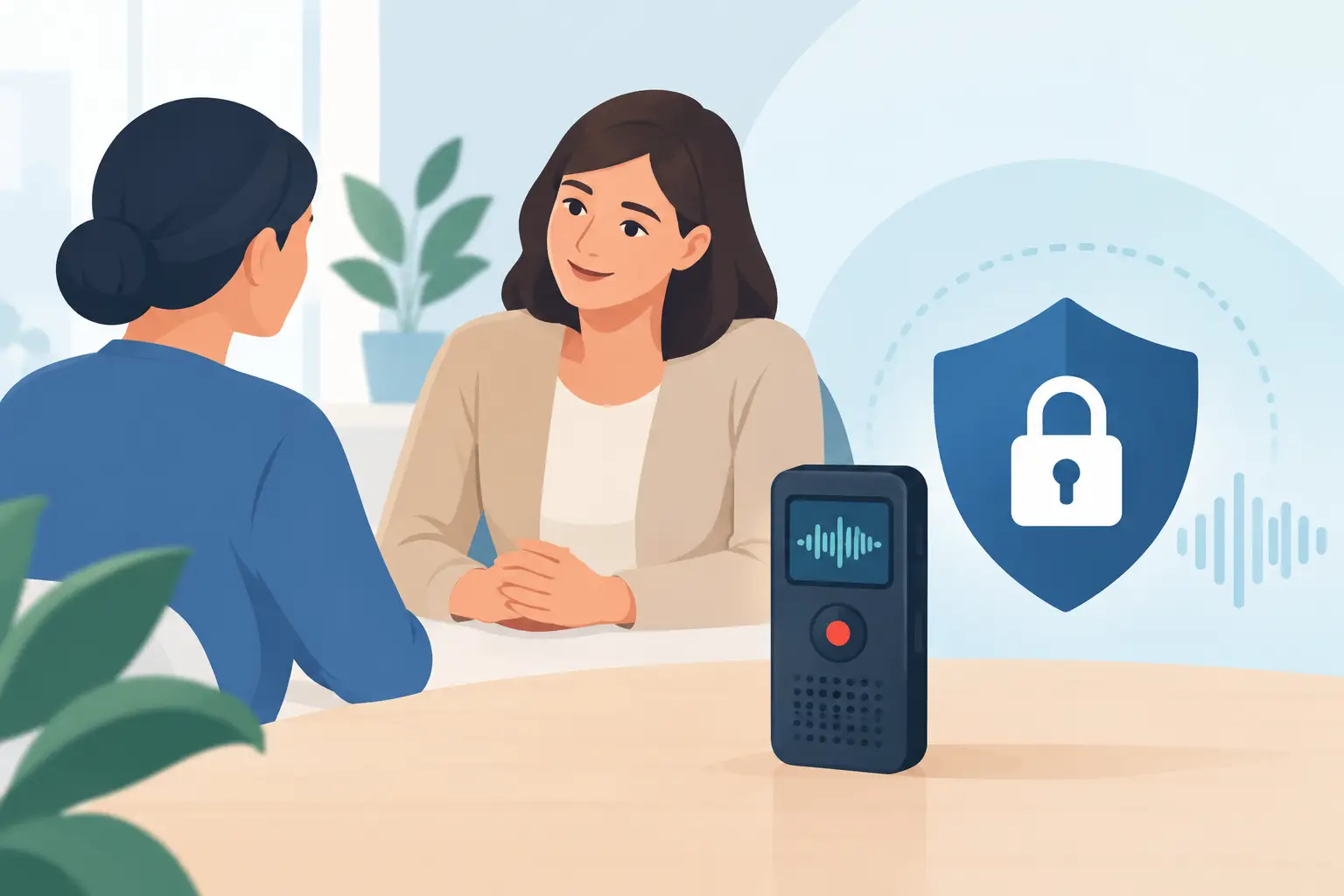
Best confidential recording practices for UK adult social care: consent, privacy, secure storage and review steps that protect staff, residents and evidence.
A supervision conversation can contain the evidence a manager needs most: a staff member recognising a medication concern, asking for support with a competency, or raising a safeguarding issue. It can also contain sensitive personal information that should never be handled casually. The best confidential recording practices protect both sides of that reality. They make recording useful, fair and defensible - without turning a human conversation into another administrative burden.
Let's be honest: writing up supervision from memory days later is not a confidentiality safeguard. It is often the opposite. Details become vague, context disappears and managers may over-record information that was not relevant to the purpose of supervision. A well-governed recording process creates a clearer, more accurate account while keeping access, retention and review under control.
Adult social care is not a generic workplace. Supervision records may touch on staff health, performance, professional confidence, safeguarding concerns, training needs and limited information about people receiving support. That means a recording process must be designed around data minimisation, dignity and accountability from the outset.
The objective is not to capture every possible detail. It is to create an accurate record of a purposeful management conversation, identify action and risk early, and retain evidence that can withstand internal audit or regulatory scrutiny. If a recording system encourages managers to collect more information than they need, keeps files indefinitely or gives broad access to raw audio, it is not supporting good governance.
Confidentiality also supports better supervision. Staff are more likely to speak candidly when they understand what is being recorded, why it is being recorded, who can see it and how it will be used. Clarity is not a formality. It is the foundation for active listening and a fair working relationship.
Recording should begin with a defined process, not a device switched on halfway through a conversation. Set the purpose clearly: this is a staff supervision, competency discussion, return-to-work conversation or another legitimate management meeting. The purpose determines what should be recorded, who needs access and how long the record should be kept.
Tell the staff member before the session that it will be recorded. Explain that the recording will support an accurate supervision record, action tracking and quality assurance, rather than replace the manager's judgement. Give them a straightforward opportunity to ask questions.
In an employment setting, consent is not always the most appropriate legal basis because of the imbalance of power between employer and employee. Your organisation should establish its lawful basis under UK GDPR with appropriate advice from its data protection lead or specialist. What matters operationally is transparency: staff should know the process in advance, understand the privacy information and be able to raise a concern without penalty.
Covert recording is rarely compatible with a culture of trust. There may be exceptional circumstances involving a serious investigation, but these require documented justification, senior oversight and specialist advice. They should never become a shortcut for poor management.
Managers cannot always prevent sensitive information arising naturally. A staff member may refer to a recent incident, a complaint or a difficult shift. The rule is to discuss the learning and required action without unnecessarily naming the person receiving support or repeating identifying details.
Use role-based language where possible: “the person involved”, “the morning shift” or “the recent medication incident”. If a specific record must be consulted later, reference the appropriate internal process rather than narrating personal details into a supervision recording. This reduces exposure while preserving the management evidence.
Use a private space, whether the supervision is in person or remote. Check who can overhear the conversation, whether notifications might interrupt and whether shared devices are involved. A manager recording a sensitive discussion on a personal phone, then sending the file through an unapproved messaging app, can undo every other safeguard.
Only use approved technology with clear organisational controls. That includes encrypted transfer and storage, named user access, multi-factor authentication where available, audit logs and a contract that sets out the provider's responsibilities as a data processor. Convenience matters, but not at the expense of control.
High-quality recording is not about creating a surveillance archive. It is about capturing the substance of a purposeful conversation accurately enough to produce a fair record.
At the start, confirm the date, attendees and purpose. Reconfirm that the session is being recorded. If the discussion moves into an unexpected area of high sensitivity, pause and consider whether it is necessary to continue recording that section. A process that allows a manager to stop, resume or flag a section for careful review is far safer than a blunt “record everything” approach.
Keep the conversation grounded in observable practice, support and agreed action. Ask what happened, what the staff member has learned, what support they need and what will change. Avoid speculative labels or statements that are not evidenced. A verbatim transcript can be valuable because it retains context, but it does not remove the need for professional judgement.
Speaker identification matters here. If a transcript cannot reliably distinguish manager from staff member, it can muddle who raised a concern, who agreed an action and who gave guidance. Strong diarisation, followed by human checking, makes the final record more useful and more defensible.
The raw recording is rarely the document you need to retain or share widely. It is source material. The useful output is a reviewed record that accurately reflects the conversation, actions, timescales and any escalation required.
Artificial intelligence can transcribe, structure and highlight possible themes at speed. It can flag language associated with safeguarding, medication, training or competency concerns, helping managers avoid missing a risk buried in a long conversation. But it cannot decide the facts, assess proportionality or replace the manager's responsibility to respond.
A named human should review the transcript and proposed report before it is finalised. Check speaker attribution, factual accuracy, context and whether unnecessary personal information has been included. Correct errors promptly and make clear when a record has been amended. Where appropriate, give the staff member a chance to review or acknowledge the agreed record, particularly where actions or performance expectations are involved.
This is where modern tools can change the workload. 1two.one, for example, converts a recorded session into a speaker-labelled transcript and structured report mapped to relevant UK regulatory frameworks, while keeping a human review stage before finalisation. The point is not to automate judgement. It is to stop managers spending 45 minutes writing up a one-hour conversation from incomplete notes.
Not every manager, administrator or senior leader needs to hear raw audio. Set role-based permissions that reflect genuine operational need. The supervising manager may need access during review; a registered manager may need the final report and escalated risk; an auditor may need evidence that the process occurred. These are different levels of access.
Keep an audit trail of who accessed, edited, exported or deleted records. It is far easier to demonstrate control when the system can show it, rather than relying on a manager's recollection months later.
A confidential recording process needs a retention schedule before the first file is created. Retain records for only as long as there is a clear employment, governance or legal reason to do so. The right period will depend on the type of discussion, organisational policy and any live concern or investigation. Avoid keeping audio “just in case”.
In many cases, retaining the approved report while securely deleting raw audio after a defined review window may be more proportionate than storing everything permanently. The decision should be documented and applied consistently. Records subject to a complaint, legal hold or safeguarding process may need different handling, so your policy should allow for justified exceptions.
Deletion must be real, not symbolic. Consider backups, exported downloads, email attachments and personal-device copies. Staff should know how to report an accidental disclosure, incorrect access permission or wrongly shared report immediately. A quick, honest response limits harm and supports proper assessment of whether the incident needs escalation.
A good confidential recording process should pass a simple test. Could you explain it clearly to the staff member, the registered manager, an auditor and a regulator? You should be able to show why you recorded, what you collected, how you protected it, who reviewed it, what action followed and when it will be deleted.
That standard does not require managers to become data protection specialists. It requires a workflow that respects people and removes avoidable ambiguity. When recording is transparent, focused and reviewed by a human, it can give managers more time to listen properly - and stronger evidence to act when a concern cannot wait.
Found this useful?
Share it with your network — help another registered manager save an hour today.