


All posts
AI Transcription Versus Manual Notes in Care
AI transcription versus manual notes: how UK care managers reduce write-up time, strengthen supervision evidence and identify risks sooner for inspection.
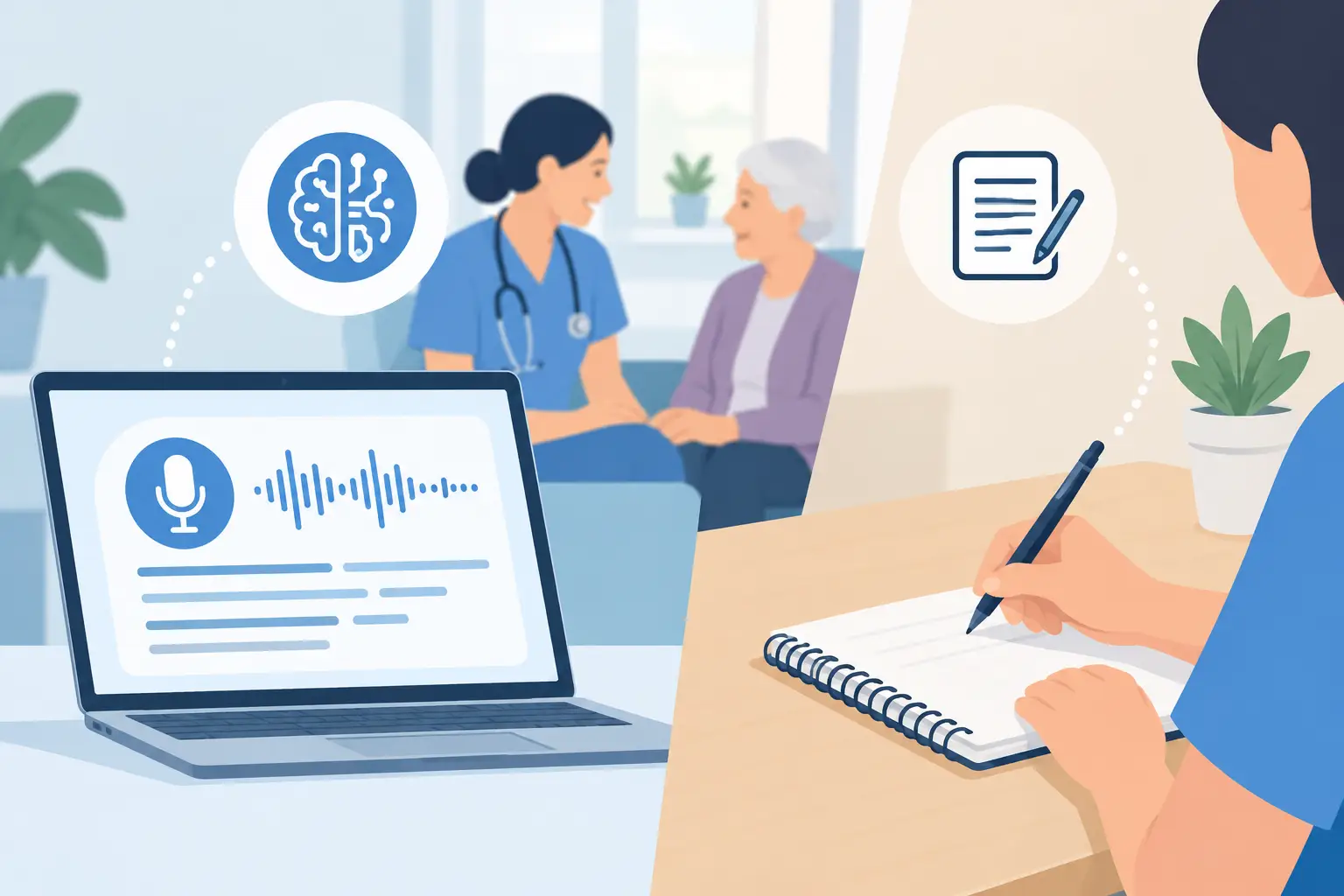
AI transcription versus manual notes: how UK care managers reduce write-up time, strengthen supervision evidence and identify risks sooner for inspection.
A one-hour staff supervision can easily become a two-hour job. The conversation itself may be focused, supportive and useful. Then comes the familiar second shift: reconstructing what was said, finding the right template, typing notes, checking wording, chasing signatures and hoping the final record will stand up to scrutiny. That is the real question behind AI transcription versus manual notes in adult social care: which method creates a record managers can trust without taking them away from their people?
Let's be honest: Supervision 1.0 is broken. Not because managers do not care about good records, but because the traditional process asks them to be fully present in a sensitive conversation and produce a detailed, compliant document at the same time. Something usually gives. It may be the quality of listening, the detail of the note, or the time needed to follow up on concerns.
Manual notes have a place. A short contemporaneous note after an incident, an observation from a meeting, or a personal prompt for follow-up can be useful. But relying on handwritten or typed notes as the primary supervision record creates predictable weaknesses.
First, notes are selective. Even the most capable manager cannot write down every relevant point while maintaining eye contact, asking good questions and responding thoughtfully. The record becomes an interpretation of the conversation rather than a reliable account of what the staff member actually said.
Second, notes are often completed later. A manager may intend to write them up straight after the session, only to be pulled into a staffing issue, a family call, medication concern or an urgent operational task. By the time they return to the document, detail has faded. The write-up becomes shorter, safer and more generic than the conversation itself.
Third, generic templates can create the appearance of compliance without providing strong evidence. A completed box marked “training discussed” does not show what training was needed, why it mattered, what the staff member said about their confidence, or what action was agreed. During inspection or internal audit, vague records create more questions than reassurance.
The cost is not only administrative. When managers are concentrating on capturing phrases for the file, they can miss the hesitation that signals a competency gap, the concern that suggests a safeguarding issue, or the passing comment that reveals someone needs more support. Good supervision depends on active listening. Manual note-taking competes with it.
The strongest comparison is not between technology and human judgement. It is between two workflows.
With manual notes, the manager runs the session, captures fragments, writes up a retrospective account, maps it to organisational requirements and sends it for signature. The process depends heavily on memory, available time and consistency across supervisors.
With AI transcription, the conversation is recorded with appropriate consent and governance. The system creates a speaker-labelled verbatim transcript, identifies key themes and produces a structured draft record. The manager then reviews it, corrects anything necessary, adds professional judgement and finalises the agreed report.
That human review is essential. A transcript is evidence of what was said, not a substitute for management. AI should not decide whether a concern requires escalation, judge a staff member’s performance in isolation, or finalise a record without oversight. Its job is to remove the burden of transcription and routine structure so managers can apply their experience where it matters.
For a typical one-hour supervision, this can avoid around 45 minutes of post-session write-up. That time is not simply reclaimed admin time. It can be used for meaningful follow-up, checking that agreed actions happen, supporting a struggling colleague or being more visible in the service.
An inspection-ready supervision record should do more than prove a meeting happened. It should show that the discussion was purposeful, person-centred and followed through.
A quality record captures the staff member’s own words where they matter. If someone says they do not feel confident with a particular medication process, the record should not reduce that to “medication discussed”. It should preserve the concern, record the agreed support and make it easy to evidence that action was taken.
It should also connect the conversation to the relevant regulatory expectations. Providers operating across the UK do not need another generic form. They need records that can be understood in the context of CQC, CIW, Care Inspectorate or RQIA expectations, while reflecting the reality of their own service.
This is where a purpose-built platform differs from a general transcription tool. General tools may turn speech into text. They do not necessarily distinguish speakers reliably, identify resident-confidentiality concerns, recognise social care risk themes or structure evidence against the frameworks that managers are asked to demonstrate.
A platform such as 1two.one is designed around that operational reality. It creates a speaker-labelled transcript, analyses the discussion against relevant regulatory frameworks, flags potential themes such as safeguarding, medication, training and competency, and prepares a report for human review and sign-off. The final record remains the manager’s responsibility, but it is no longer dependent on a rushed reconstruction of the conversation.
AI transcription is not automatically right for every conversation. Services need clear recording procedures, a lawful basis for processing, transparent communication with staff and secure handling of sensitive information. Managers must know when recording is appropriate and how long information is retained.
Data protection should be a deciding factor, not an afterthought. Consumer transcription apps may store data outside the UK, train models on submitted material, offer limited control over retention or make it difficult to demonstrate appropriate safeguards. For adult social care, that risk is too high. The provider should be able to explain encryption, access controls, UK data protection arrangements, confidentiality screening and how recordings and reports are managed.
Accuracy matters too. Background noise, overlapping speech, strong accents and names can challenge any transcription system. That is why good speaker diarisation and a proper review stage are not optional extras. The manager needs a clear, efficient way to check the record before it becomes part of a staff file.
Manual notes may remain appropriate for an informal check-in, a brief operational conversation or circumstances where recording is not suitable. The point is not to record everything. It is to stop treating long, structured supervisions as though a manager’s memory and a blank template are the safest available system.
The most effective model is simple. Start the session by setting expectations and confirming that it will be recorded in line with your organisation’s process. Then hold the conversation properly: listen, ask follow-up questions and give the staff member time to speak.
Afterwards, review the generated transcript and structured report. Check names, context, actions and any risk flags. Add the judgement only a manager can provide, including the priority of actions and the support required. Once both parties have reviewed the outcome, finalise the signed record and ensure agreed actions are followed through.
This creates a clearer audit trail without turning supervision into a compliance performance. It also makes records more consistent across teams. A manager in a small domiciliary branch and an operational lead overseeing multiple homes should be able to evidence the same standard of thoughtful, accountable practice without each inventing their own paperwork process.
The debate over AI transcription versus manual notes is often framed as a question of speed. Speed matters, particularly when managers are carrying relentless administrative pressure. But the more meaningful benefit is attention.
When the system captures the detail, managers can be more present. When reports are grounded in actual words, staff are less likely to be reduced to generic statements. When potential risks are surfaced quickly, action can begin sooner. And when inspection evidence is built routinely rather than assembled in panic, governance becomes part of everyday practice.
Good supervision should feel like support, accountability and development - not a race to complete a form before the next interruption. The right technology does not make the manager less human. It gives them more room to do the human part well.
Found this useful?
Share it with your network — help another registered manager save an hour today.