
All posts
Supervision in Social Care: What the Data Tells Us
I asked my social care network how they record supervision. A near-perfect three-way split — and 48% spending 30+ minutes per session — says more than the polls alone.
I asked my social care network how they record supervision. A near-perfect three-way split — and 48% spending 30+ minutes per session — says more than the polls alone.
Over the past few weeks I've been asking a simple question to my social care network: how do you record what was discussed in supervision?
The result was a near-perfect three-way split — a third typing during the session, a third typing it up afterwards, a third doing something else entirely.
That spread was striking in itself. Everyone has found their own workaround.
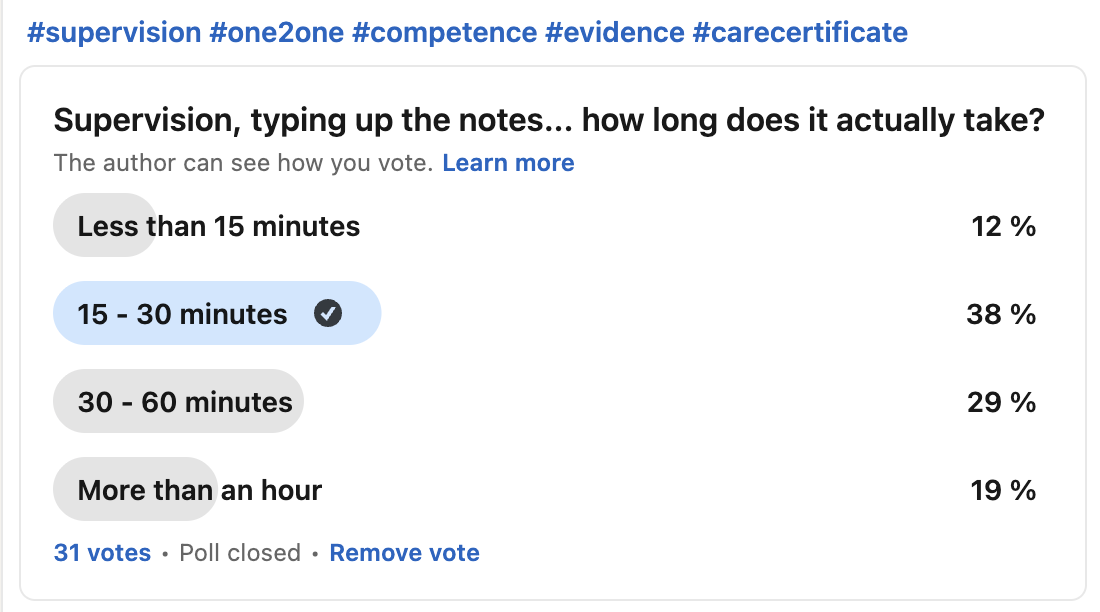
So I asked a follow-up question: how long does the documentation actually take?
The answers were even more revealing. Almost half — 48% — said documentation takes 30 minutes or more per session. One in five said it takes over an hour. That's not a documentation task. That's a second meeting.
According to the Skills for Care Size and Structure report, there are thousands of settings employing between 30 and 60 staff. Imagine the documentation time with just 30 staff — let alone the larger domiciliary care providers managing 120 or more.
I've spent the past week in conversation with people I trust from across the sector — managers, consultants, a former CQC inspector — and what emerged was something more nuanced than a time problem.
The providers doing supervision well aren't trying to do it faster. They're doing more of it.
One person told me that to do supervision properly, you spend almost as much time preparing as you do in the session itself. They weren't talking about a quick skim of last month's notes. They were talking about pulling together feedback from people supported, reviewing complaints and incidents since the last session, checking training records, and reflecting on any practice observations made in the intervening weeks.
That's not admin. That's what separates good and outstanding providers.
Someone else told me their supervision write-up takes less than 15 minutes, because they were already using AI to transcribe and summarise the session, which saved their managers time.
In the middle of all these sector conversations, I spoke to my aunty. She works in a care home. Supervisions happen every three months and it's all handwritten.
My LinkedIn network skews toward engaged, digitally active professionals. The reality across the sector is likely harder than the polls suggest. What is clear is that savings and improvements can be made — because some providers are already making them.
This is the first in a short series on supervision in social care — what the data shows, what the sector told me, and what needs to change.
Found this useful?
Share it with your network — help another registered manager save an hour today.