


All posts
7 Signs of Weak Supervision Records in Care
Spot the signs of weak supervision records before an inspection or incident exposes gaps. Build clear, timely, defensible evidence in adult social care.
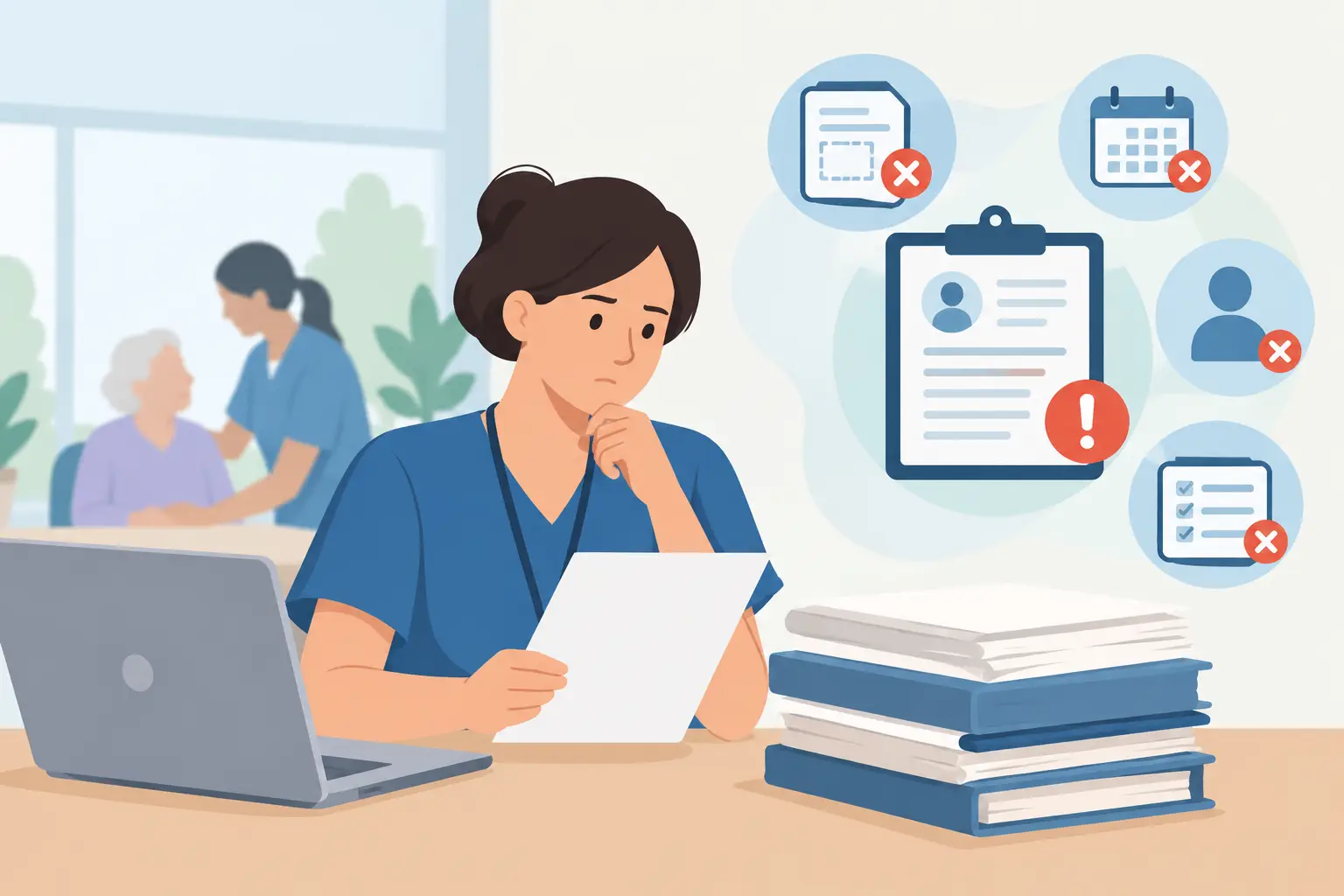
Spot the signs of weak supervision records before an inspection or incident exposes gaps. Build clear, timely, defensible evidence in adult social care.
A supervision can be thoughtful, supportive and professionally challenging - then become almost impossible to evidence because the record says little more than “discussion held” and “no concerns raised”. The signs of weak supervision records are rarely dramatic at first. They show up in rushed write-ups, repeated wording and missing follow-up, until an inspection, complaint or safeguarding concern exposes how little the organisation can actually demonstrate.
Let’s be honest: managers do not create vague records because they do not care. They are balancing staffing gaps, family calls, incidents, handovers and the daily work of keeping a service safe. But supervision paperwork that cannot show what was discussed, what was agreed and what happened next is not harmless administration. It weakens governance and denies staff the development and support they deserve.
A record is not a substitute for a good conversation. It is the evidence that a good conversation took place, that concerns were heard and that appropriate action followed. Inspectors may look for different forms of evidence depending on the nation and regulator, but the underlying test is familiar across adult social care: can the provider show effective oversight, competent staff, safe escalation and continuous improvement?
A thin supervision note makes that difficult. It can leave a registered manager unable to evidence that a medication concern was explored, that a training gap was addressed, or that a staff member received appropriate support after raising a safeguarding issue. It also creates unfairness. Months later, neither the manager nor the employee should have to rely on memory alone to establish what was said.
The quality of the record matters as much as whether the supervision happened.
“Staff member is happy.” “No issues discussed.” “Continue good work.” These phrases may be true, but on their own they are not evidence of meaningful supervision. When nearly identical notes appear month after month, they suggest the template has become the task rather than a prompt for a proper conversation.
A stronger record captures the substance of the discussion in a proportionate way. It shows what the staff member reflected on, what feedback was given, and whether any practice, wellbeing, competency or workload matter needed attention. It does not need to be pages long. It does need to be specific enough to be credible.
Delayed notes are one of the most common weaknesses in supervision records. The longer the gap, the more likely it is that key details are lost, wording becomes reconstructed and actions are never properly recorded.
There will be exceptions. A manager may need to respond to an urgent event or cover a shift. The problem is not the occasional delay; it is a pattern where records are backfilled before an audit or signed long after the conversation. That creates a fragile audit trail and makes timely risk management harder.
“Look into training” is not an action plan. Neither is “manager to monitor” without saying what will be monitored, why, and when the outcome will be reviewed.
Useful actions name an owner, a clear next step and a realistic timescale. For example, a discussion about confidence with a particular task might lead to observed practice by a named senior within two weeks, followed by review at the next supervision. That level of clarity supports the employee and gives managers something they can actually track.
A supervision record may mention a safeguarding concern, unsafe practice, medication uncertainty, fatigue or a competency issue. If the note ends there, it raises a serious question: what happened next?
Not every concern requires the same response. Some need immediate escalation under local policy; others may require coaching, supervision of practice, training or closer management oversight. The record should demonstrate appropriate judgement without including unnecessary personal detail. It should show that the concern was recognised, considered and acted upon through the right route.
Records written entirely from a manager’s perspective can read as a verdict rather than a supervision. Phrases such as “advised staff to improve” offer little insight into whether the employee understood the feedback, raised barriers or agreed the action.
Good supervision is active listening as well as direction. A defensible record distinguishes between what the staff member said, what the manager observed and what was mutually agreed. This is particularly important where there is disagreement, a wellbeing concern or a performance matter. Speaker-labelled, verbatim source material can be valuable here, provided it is reviewed and handled securely before any final report is produced.
A signature confirms more than attendance. It should show that the record has been seen and that the employee has had a fair opportunity to comment. If every record is unsigned, signed months later or approved without review, the process loses credibility.
Staff do not have to agree with every point for a record to be completed. Where they disagree, that should be captured professionally. A clear record of their comments is often stronger than forcing artificial agreement, because it demonstrates openness and appropriate management response.
If supervision notes sit in notebooks, personal drives, inboxes and disconnected spreadsheets, a provider cannot confidently answer basic governance questions. Which supervisions are overdue? Are themes emerging across a service? Have all actions been closed? Which sites need additional support?
This is where paper-based Supervision 1.0 is broken. It asks managers to hold a meaningful conversation, manually write it up, file it correctly, spot risks and produce inspection evidence - often after the working day should have ended. The result is predictable: inconsistent records and delayed oversight.
Strong does not mean excessively long or full of compliance language. It means the record is accurate, timely and useful to the person receiving supervision as well as the manager accountable for quality.
It should establish the date, participants and purpose of the conversation, then reflect the issues actually discussed. It should record relevant feedback, learning needs, concerns, agreed actions and review arrangements. Where a topic relates to safeguarding, medicines, competency or training, the record should make the response visible rather than burying it in free text.
Context matters. A short record may be entirely appropriate where a routine discussion identified no actions and the employee was well supported. A more detailed account may be necessary after a serious concern or sustained capability issue. The aim is not to standardise every conversation into the same script. It is to create evidence that is proportionate to the discussion and defensible if reviewed later.
The most reliable improvement is to remove the gap between talking and documenting. Rather than asking managers to recreate an hour-long meeting from memory, record the conversation with appropriate transparency, create a transcript, and turn it into a structured report for human review.
That is the practical model behind 1two.one. Its ambient AI captures the conversation, produces speaker-labelled verbatim transcripts and maps relevant discussion against the frameworks used by CQC, CIW, the Care Inspectorate and RQIA. It can surface references to safeguarding, medication, competency and training so managers can respond promptly, while the final record remains subject to human review before it is signed.
Technology is not a reason to stop listening. Used properly, it gives managers more room to listen because it removes the pressure to type notes while an employee is speaking. It also needs the right controls: encrypted handling, UK data protection practices, screening for resident confidentiality and clear organisational rules on consent, access and retention.
Before approving a supervision note, ask whether an independent person could understand the discussion and see what happens next. Could they identify the employee’s perspective, the manager’s response and any agreed action? Could they see that a risk was escalated appropriately? Could they find the record quickly if asked six months from now?
If the answer is no, the solution is not another generic template. Give managers a workflow that protects the conversation, captures the evidence and makes follow-through visible. Better records are not bureaucracy done more neatly. They are proof that people were heard, support was real and concerns did not get lost between one supervision and the next.
Found this useful?
Share it with your network — help another registered manager save an hour today.