


All posts
GDPR Compliant Care Transcription for Supervision
GDPR compliant care transcription protects staff and resident confidentiality while giving care managers audit-ready supervision evidence without delayed notes.
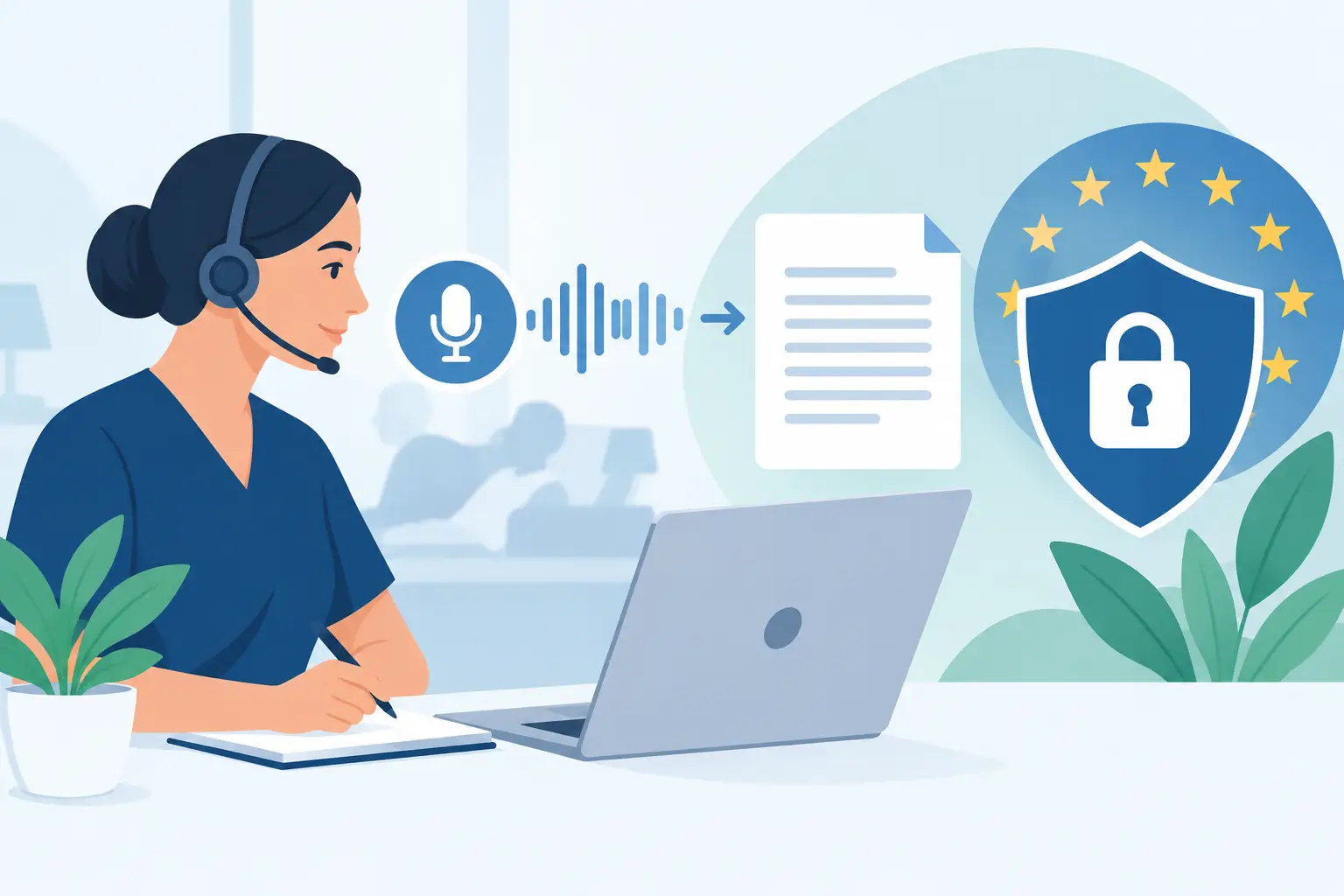
GDPR compliant care transcription protects staff and resident confidentiality while giving care managers audit-ready supervision evidence without delayed notes.
A supervision conversation can contain a great deal more than a manager’s appraisal of performance. It may include concerns about a resident, a medication incident, a safeguarding disclosure, sickness, training gaps or a colleague’s conduct. GDPR compliant care transcription is therefore not simply a question of converting speech to text accurately. It is about creating a defensible record while protecting people whose information may be discussed.
Let’s be honest: Supervision 1.0 is broken. A manager holds a thoughtful, person-centred conversation, then faces 45 minutes or more of typing it up from memory. Notes are shortened, delayed or completed between urgent calls. The result may be a generic template that proves a meeting happened, but not what was actually discussed, agreed or escalated.
For adult social care providers, the answer is not to record everything without thought. It is to use transcription with clear purpose, appropriate controls and human judgement.
A transcript is personal data when it identifies, or could identify, a staff member, resident, relative or other individual. In many cases, the content will also include special category data, such as health information, and may contain information about alleged misconduct or safeguarding matters. Recording the conversation does not remove those responsibilities. It increases the need to handle information deliberately.
The central GDPR principles are practical rather than theoretical. You should know why you are recording, collect only what is needed, keep it accurate, restrict access, protect it properly and retain it only for a defined period. A transcript that is useful for supervision, governance and inspection must still be fair to the people named within it.
This matters particularly in care because managers cannot always predict where a conversation will go. A staff member may mention a resident by name while describing a difficult shift. They may disclose a health condition affecting their work. A seemingly routine discussion can become a safeguarding issue in minutes. Your process must cope with that reality rather than pretending it will not happen.
Compliance is not a badge attached to a transcription tool. It is a workflow. The technology, your internal policies and the manager’s review all need to work together.
Providers should establish the lawful basis for processing before recording supervisions, with advice from their data protection lead where necessary. For an employment-related supervision process, consent is often not the safest foundation because staff may not feel able to refuse freely. The right basis depends on the organisation, the purpose of the processing and the data involved.
Staff should be told plainly that conversations are recorded, why this happens, who can access the record, how long recordings and transcripts are held, and how they can raise concerns. This should sit within a clear privacy notice and supervision process, not appear as a surprise at the start of a meeting.
Transparency is also good management. When a colleague understands that recording replaces rushed recollection with an accurate account of their own words, it is easier to build trust. But transparency does not mean giving up boundaries. Managers should still ask staff to avoid unnecessary resident identifiers where a concern can be explained without them.
Data minimisation is often misunderstood as a demand for poor records. It is not. The aim is to capture relevant evidence without turning every supervision into an unlimited repository of sensitive information.
A practical approach is to record the scheduled supervision, state the purpose at the outset and keep discussion focused on support, capability, conduct, wellbeing, training and service quality. If a serious safeguarding concern arises, the manager should follow the organisation’s escalation process. The transcript may evidence that concern was raised, but it should not become a substitute for a proper safeguarding record or investigation process.
The same principle applies to resident confidentiality. A system should be able to identify likely resident references for review, giving the manager a chance to check whether details are necessary, appropriately handled or need redacting before the record is finalised.
Security cannot begin after a transcript has been generated. Audio, text and reports all need protection in transit and at rest, with access limited to people who genuinely need it. Role-based permissions matter: a registered manager, HR colleague, operational lead and individual staff member may have different legitimate reasons to view a record.
Ask direct questions of any provider. Where is information stored? Is it encrypted? Who can access it for support or system administration? Is data used to train models? Can you export, correct or delete records in line with your retention rules? What happens if an account is closed? A vague answer is not a reassurance.
For UK care providers, it is also sensible to understand where processing takes place and whether international transfers are involved. The right arrangement will vary, but you should be able to document your decision-making, supplier checks and contractual controls. If the processing is likely to create a high risk to people’s rights and freedoms, a data protection impact assessment may be required.
Transcription is powerful, but it is not infallible. Accents, clinical terminology, acronyms, overlapping voices and emotionally difficult conversations can all affect accuracy. More importantly, an AI system cannot carry the accountability for a management decision.
A strong process uses speaker diarisation to distinguish who said what, produces a verbatim transcript, then gives the manager a review stage before anything becomes an official record. The manager can correct mistakes, add context, confirm actions and remove irrelevant sensitive detail. The staff member can then review and sign the agreed report where your procedure requires it.
That review is not bureaucratic duplication. It is the point at which a useful transcript becomes a fair, accurate and audit-ready supervision record.
The value of a well-designed system is not just speed. It is the ability to connect real discussion to the standards managers are expected to evidence. A good supervision record can show how the organisation supports staff competence, raises concerns, responds to risk, promotes learning and maintains accountability.
This is where generic templates often fail. A tick-box asking whether training was discussed tells an inspector very little. A speaker-labelled record showing that a worker raised uncertainty about medicines, that the manager checked competence, arranged refresher training and set a review date is materially stronger. It captures the issue, the response and the rationale in the context of the actual conversation.
1two.one is built around this record-to-report workflow. It records the supervision, creates a speaker-labelled transcript, maps relevant discussion to the appropriate CQC, CIW, Care Inspectorate or RQIA framework, and flags themes such as safeguarding, medication, competency and training for manager review. The final signed PDF provides a clearer audit trail without asking managers to write the same meeting twice.
There is an important distinction here. Automated analysis can highlight what deserves attention; it should not decide that a concern has been safely resolved. A medication reference could be a routine competence discussion, an admission of an error or a concern requiring immediate escalation. Context and professional judgement remain essential.
Many providers focus on getting records created, then leave them in a folder indefinitely. GDPR requires more discipline. Set a retention schedule that explains how long audio, transcripts and final reports are kept, and distinguish between them where appropriate. Raw audio may not need to be retained for as long as an approved supervision report.
Accuracy also needs a route for correction. Staff should be able to challenge a transcription error or provide their view where the record is incomplete. Keep an audit trail of amendments rather than silently overwriting a disputed point. This protects the individual and strengthens the credibility of the record later.
Finally, test access in the real world. A multi-site provider may need group-level oversight, while a local manager should only see records for their own service. Former employees, agency staff and managers who move roles can expose gaps in permissions if offboarding is not prompt. Good governance is often won or lost in these ordinary details.
The goal is not to turn supervision into surveillance, nor to bury managers in another compliance project. It is to protect the quality of a conversation that already matters. When staff are listened to properly, concerns are captured accurately and actions are visible, the record becomes evidence of good leadership rather than proof that someone completed a form.
Start by reviewing one supervision journey from recording to retention. If the process relies on memory, shared inboxes and generic notes written days later, there is a better way to protect confidentiality and give your managers time back for the work only they can do.
Found this useful?
Share it with your network — help another registered manager save an hour today.